


Why Settle for Hoping When We Can Start Navigating?
If you’ve ever sat through a financial advisor’s pitch or read a swanky investment brochure, you’ve likely heard this classic line: “Missing the 10 best days in the stock market can tank your returns”. It’s a compelling soundbite, often backed by charts showing how a hypothetical investor who stayed fully invested crushed the poor sap who missed those golden days. This narrative smells a lot like a fear of missing out (FOMO) tactic, designed to keep clients locked into a “buy and hold” strategy, even when present-day technology offers smarter ways to navigate the market’s ups and downs.
The argument hinges on historical data; the stock market’s biggest gains often come in short, unpredictable bursts. Miss those days, and your long-term returns could take a hit. While it’s not wrong, math doesn’t lie, it’s only half the story. What these pitches conveniently gloss over is that the market’s worst days often cluster near the best days. Timing the market perfectly is impossible, sure, but the idea that you’re doomed if you miss a handful of outliers ignores the bigger picture: volatility cuts both ways.
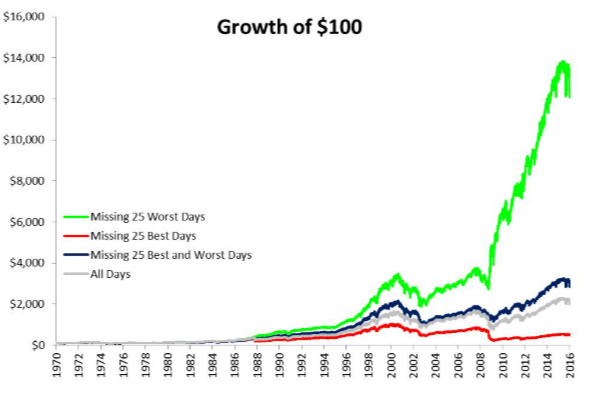
In reality, missing the 10 best days might also mean dodging the 10 worst. Studies, like those from Michael Batnick of Ritholtz Wealth Management, have shown that avoiding the market’s biggest drops can actually boost returns more than chasing its biggest pops. So why does the “don’t miss out” mantra get all the airtime? Simply put: it keeps clients invested and portfolios humming along on autopilot, whether it’s the best move or not.
FOMO: The Emotional Hook
Let’s be honest, FOMO is a powerful drug. It’s the same reason people camp out for Black Friday deals or panic buy meme stocks. Wall Street knows this. By framing market timing as a fool’s errand and dangling the specter of “missing the 10 best days”, advisors tap into that primal fear of being left behind. It’s a psychological nudge to stay the course, even when markets get rocky. And for decades, that made sense, as most investors didn’t have the tools to do much else.
But here’s the kicker: it’s not 1980 anymore. Technology has flipped the script.
The Modern Advisor’s Toolkit: Smarter Investing
Today, advisors have access to tools that would’ve been science fiction a generation ago. Real-time data, algorithmic trading, AI-powered analytics, charting software, and technical analysis. These tools enable us to monitor trends, catch risks, and tweak strategies at lightning speed. Now you don’t need to be a hedge fund genius to spot trouble brewing. Advisors just need to weave these tools into their workflow, invest the time and effort, and stay agile in a market that never stops shifting.
A Tactic Past Its Prime
The “don’t miss the 10 best days” line worked when staying invested was the only practical option. It kept clients from panic selling and abandoning ship. But hammering that same point today, when tech gives us ways to handle risk smarter, feels off. In the end, it’s FOMO dressed up as wisdom, nudging you to ignore the tools at your fingertips and stick with the status quo.
Does this mean you should day-trade the roller coaster the market is? Of course not, timing the market is still hard, and no tactical strategy is foolproof. But it does mean the conversation should shift. Instead of scaring clients into staying fully invested 24/7, advisors could lean into tech to build flexible, responsive plans for ALL market conditions. The goal isn’t to catch every “best day”, it’s to grow wealth without getting blindsided by the worst ones.
The Bottom Line
Missing the 10 best days isn’t the disaster it’s made out to be, it’s a cherry-picked stat meant to keep you hooked. In 2025, with tech more accessible than ever, you don’t have to choose between blind optimism and reckless timing. The market’s turbulent? Good. At Maverick Wealth Advisors, we’ve got the tools to handle it. So next time someone trots out the FOMO line, ask them: Why settle for hoping when we can start navigating?
Past performance is not indicative of future results. While various investment strategies exist, no strategy can guarantee avoidance of market downturns or the maximization of returns. Advisory Services offered through Concurrent Investment Advisors, LLC an SEC Registered Investment Advisor. Concurrent Investment Advisors, LLC d/b/a Maverick Wealth Advisors are not affiliated companies.
Sources:
Batnick, M. (2016, February 17). How missing out on 25 days in the stock market over 45 years costs you dearly. MarketWatch. https://www.marketwatch.com/story/how-missing-out-on-25-days-in-the-stock-market-over-45-years-costs-you-dearly-2016-01-25
Batnick, M. (2019, February 8). Miss the worst days, Miss the Best Days. The Irrelevant Investor. https://www.theirrelevantinvestor.com/p/miss-worst-days-miss-best-days
Idris, H. (2024, October). The Effects of FOMO on Investment Behavior in the Stock Market. ResearchGate.https://www.researchgate.net/publication/385392144_The_Effects_of_FOMO_on_Investment_Behavior_in_the_Stock_Market
Occam Investing. (2019, December 29). Problems with the “X best days” argument. Occam Investing. https://occaminvesting.co.uk/problems-with-the-x-best-days-argument/#:~:text=The%20best%20days%20and%20the%20worst%20days%20happen%20so%20close,than%20missing%20the%20X%20best